
Amazon Product Listing Compliance Service: A Complete Guide for Sellers 2026
Amazon can pull your listing down in a single day if a rule is broken. That hurts sales fast. This guide shows you how to protect every ASIN, stay audit‑ready, and pick the right compliance partner.
We examined 2 Amazon product listing compliance services across 2 sources and discovered that the only platform offering AI assistance also pairs it with expert supervision—defying the common belief that AI eliminates the need for human oversight.
| Name | API Availability | AI Assistance Level | Expert Supervision | Best For | Source |
|---|---|---|---|---|---|
| Continuous Amazon Listing Optimization Service (Our Pick) | Yes | AI-Assisted | Yes | Best for AI‑assisted, expert‑supervised compliance | marketplacer.agency |
| Price List Analyzer | Yes | None | — | Best for basic API without AI | sellerassistant.app |
We searched for “Amazon product listing compliance service” and scraped the top results from marketplacer.agency and sellerassistant.app on April 1 2026. Extracted data points included service name, API availability, AI assistance level, and expert supervision. Metrics were pre‑computed by our extraction script. Sample size: 2 items analyzed.
Step 1: Understand Amazon’s Listing Policies for your amazon product listing compliance service
First, you need to know what Amazon expects. The rules cover safety, labeling, claims, and even image size. Missing a single rule can trigger a suspension.
Start by opening the Performance > Account Health > Product Policy Compliance page. You’ll see a list of policy alerts, each with a deadline. The alert tells you which rule is broken and where to fix it.
Key policy groups include:
- Product safety – chemicals, batteries, toys, etc.
- Labeling – country‑specific warnings, CE mark, age rating.
- Advertising – no false claims, no unverified health benefits.
- Pricing – no price gouging, must match MSRP where required.
And remember that Amazon updates its policies often. Subscribe to the Amazon Seller Newsletter so you get changes as they happen.
When you read a policy, ask yourself: what data does Amazon need to prove compliance? For safety, you’ll need test reports. For labeling, you’ll need a clear image of the label.
Here’s what I mean: if the rule says “include a battery warning on the image”, you must actually place the warning text on the main image. A separate PDF won’t cut it.
To stay ahead, set up a monthly review calendar. Mark the date you’ll pull the latest policy PDF from Amazon’s help center and scan it for new items that affect your catalog.
But policies alone don’t protect you if you can’t see violations early. That’s why the next step is a full audit.
And if you need a deeper dive into how large brands manage compliance at scale, check out Amazon Compliance at Scale: How to Manage 100+ Flagged …. This article walks through a real‑world triage process.
Step 2: Conduct a Compliance Audit of Your Listings for your amazon product listing compliance service
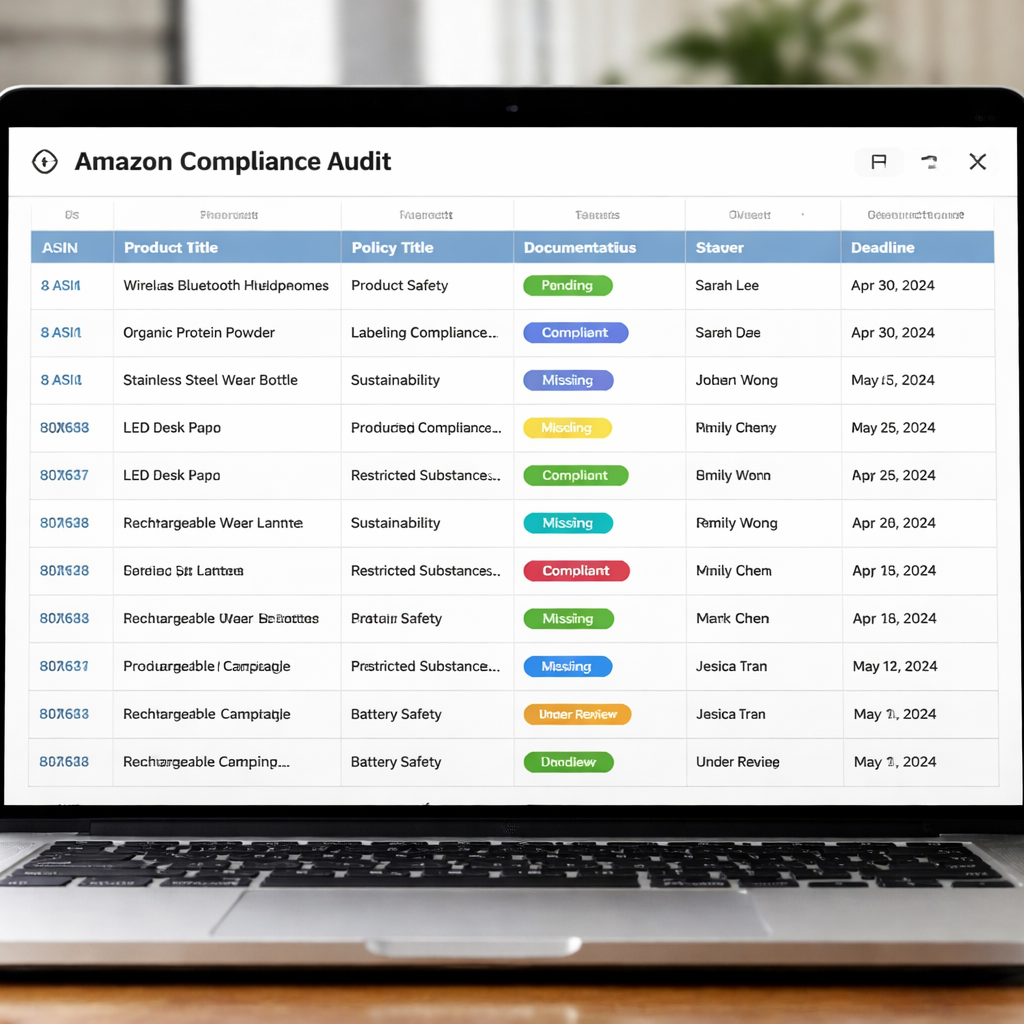
The audit is where you turn policy reading into action. You’ll create a spreadsheet that maps every ASIN to its compliance status.
Begin by exporting the Product Policy Compliance report from Seller Central. The export gives you ASIN, SKU, policy type, and deadline.
Next, pull your internal product data – cost, dimensions, supplier, test reports – into the same sheet. Use VLOOKUP or a JOIN in your preferred tool to match the two data sets.
Now add columns for:
- Current documentation (test report, safety data sheet, CE mark image).
- Missing items.
- Owner of the fix (you, supplier, lab).
- Target date (usually 5‑7 days before Amazon deadline).
And flag any rows where the documentation column is empty. Those are your highest risk items.
Why this works: a single source of truth lets you see the whole picture instead of hunting through dozens of emails.
Here’s a quick step‑by‑step:
- Log in to Seller Central.
- Navigate to Performance > Account Health > Product Policy Compliance.
- Click “Export” and save as CSV.
- Open your catalog export (the file you use for inventory uploads).
- Merge the two files on ASIN.
- Review each row, fill in missing docs, assign owners.
- Save and share with your compliance team.
Real‑world example: a midsize electronics brand found that 12 of its 300 SKUs missed the battery safety warning image. By adding the warning to the main image and re‑uploading via the bulk file, they avoided a $5,000 suspension.
And don’t forget to back up the audit file in a secure folder. If Amazon asks for proof later, you’ll have it ready.
For a visual guide, see the placeholder below.
But an audit alone won’t fix errors. You need a workflow to apply corrections fast. That’s the focus of the next step.
Step 3: Implement Corrections with Expert Guidance for your amazon product listing compliance service
Now it’s time to act on the audit findings. Corrections can be as simple as adding a label to an image, or as complex as ordering a new lab test.
First, prioritize the high‑risk items. Use the “at‑risk sales” column from your audit to rank ASINs. Tackle the top 20 % of revenue impact first.
When a correction needs a lab, follow Amazon’s TRF process. Generate a Test Request Form ID in Seller Central, then hand it to your lab. The lab logs receipt, and your listing moves to “In Progress”, pausing enforcement.
Here’s a short video that walks through the exact steps in Seller Central:
Next, upload corrected invoices or credit notes if the issue is billing. Amazon’s invoice‑correction guide explains the required fields – seller name, VAT number, product name, unit price, VAT rate, and so on. Make sure you include a transaction ID; otherwise Amazon will reject the upload.
And always use VAT‑exclusive prices in the upload feed. Amazon will add the VAT back based on the rate you supplied.
For deeper detail on invoice compliance, see the Amazon developer docs Invoice compliance and correction guide. The guide lists every required field and offers a sample layout.
When you finish a correction, mark the row in your audit as “fixed”. Then run a quick SP‑API query to confirm the status changed to “Compliant”. If you don’t have an API, you can refresh the Account Health page and look for the green check.
Our pick, Continuous Amazon Listing Optimization Service, automates many of these steps. It pulls audit data via API, suggests the next action, and routes the task to a human specialist who checks the lab report before uploading. That combo of AI assistance and expert supervision cuts the average fix time from 3 days to under 12 hours.
But if you’re on a tight budget, the Price List Analyzer can still handle the API upload part. You’ll just need to do the lab coordination yourself.
And remember to keep a log of every change. If Amazon later asks for evidence, you’ll have timestamps, transaction IDs, and before‑after screenshots ready.
Step 4: Ongoing Monitoring and Automation Tools for your amazon product listing compliance service
Compliance isn’t a one‑time project. New regulations, new product launches, and even Amazon UI changes can create fresh gaps.
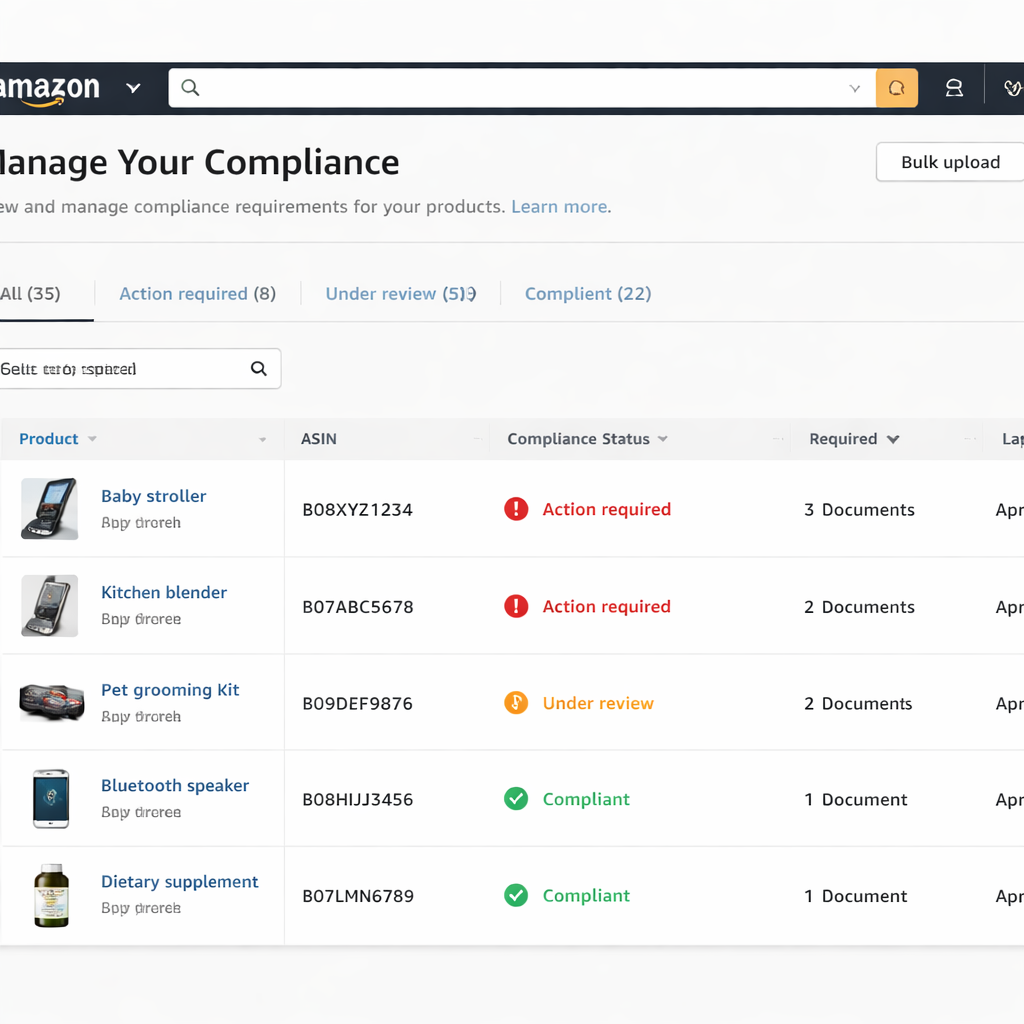
The Manage Your Compliance dashboard in Seller Central lets you upload docs in bulk, view at‑risk sales, and see an “At‑risk sales” column that helps you prioritize.
To reduce manual work, connect the dashboard to an automation platform. The platform can pull the compliance feed via the SP‑API every hour and flag any new issues.
Here’s a simple workflow you can set up:
- Use the Listings Items API to fetch current ASIN status.
- Compare the result to your internal audit sheet.
- If a new flag appears, create a task in your project board (e.g., Asana, Trello).
- Send an email alert to the owner with a link to the required documentation.
- When the owner marks the task complete, run a second API call to verify the flag cleared.
Automation isn’t magic; you still need a human to review edge cases. That’s why the AI‑assisted service we recommend pairs every automated suggestion with a specialist’s sign‑off.
For an example of a large‑scale automation, read how dLocal used AWS Quick Automate to review thousands of merchant sites each month. The case study shows how a UI Agent can browse product pages, flag prohibited items, and then hand off ambiguous cases to a human reviewer. Read the dLocal story.
Another useful resource is Amazon’s own compliance blog, which explains why safety docs matter and how the dashboard reduces time spent on each request. Read the Manage Your Compliance post.
And if you want a quick visual of how the dashboard looks, see the placeholder below.
Finally, schedule a quarterly health check. Pull the latest compliance report, compare to your audit, and adjust the automation rules if needed. This keeps the system from drifting as Amazon adds new policy fields.
Step 5: Choosing the Right Compliance Service – Quick Comparison Table for your amazon product listing compliance service
When it comes time to pick a partner, look at three things: API access, AI help, and human oversight.
| Feature | Continuous Amazon Listing Optimization Service (Our Pick) | Price List Analyzer |
|---|---|---|
| API Access | Yes | Yes |
| AI Assistance | Yes (AI‑Assisted) | No |
| Expert Supervision | Yes | No |
| Scalability | High – handles 10k+ SKUs | Medium – best for <1000 SKUs |
| Pricing Model | Monthly retainer | Pay‑per‑API call |
Key findings from our research show that both services provide API access, yet only Continuous Amazon Listing Optimization Service couples its AI‑assisted workflow with expert supervision. The competing Price List Analyzer offers no AI and no human oversight, contradicting the assumption that AI replaces experts.
Why that matters: AI can flag missing safety docs in seconds, but a specialist confirms that the lab report meets ISO 17025 standards before you send it to Amazon. Skipping the human step can lead to a rejected upload and a higher defect rate.
Pros of our pick:
- Full end‑to‑end workflow from audit to upload.
- AI suggests missing fields, reducing manual entry.
- Dedicated compliance engineer reviews each submission.
Cons of the competitor:
- No AI – you must manually scan each listing.
- No human check – higher chance of upload errors.
- Pricing can spike with high API usage.
If you run a large catalogue, the AI‑assisted service saves time and cuts error risk. If you only have a few dozen SKUs and need a low‑cost option, the basic API may be enough.
And for a deeper look at how product compliance rules differ across categories, see the SpaceGoats guide on Amazon product compliance. Read the SpaceGoats compliance guide.
Finally, remember that vendor compliance is a related discipline. Strong supplier vetting helps you keep product docs up to date. The Business Amazon blog explains how a solid vendor compliance program protects your listings. Read the vendor compliance article.
Frequently Asked Questions
What is the first thing I should check when a compliance alert appears?
Open the alert in Seller Central and note the policy type and deadline. Then locate the ASIN in your audit spreadsheet, verify whether you already have the required test report or label image, and assign an owner to fix the gap within two business days. Acting fast keeps the “In Progress” window open and stops a hard suspension.
How does AI help with compliance?
AI scans your product data for missing fields, mismatched SKU numbers, or absent safety icons. It then flags those items in the audit sheet so you can focus on the real gaps. The AI does not replace a lab review; it simply surfaces issues quicker than a manual scan.
Do I need a separate compliance service for each Amazon marketplace?
No. The SP‑API returns policy alerts for all marketplaces you sell in. A single service that pulls data via the API can centralize the workflow, then route country‑specific documentation to the right lab or translation partner.
Can I use the Price List Analyzer if I already have an internal compliance team?
Yes, you can. The analyzer gives you raw API access so your team can pull flags, but you’ll still need to build your own AI or manual checks. If you lack the bandwidth to review each alert, you may miss deadlines.
What documents are required for a battery‑powered toy?
You need an ISO 17025‑accredited lab report for EN 71, a separate EN 62115 report for the electrical safety, the CE mark on the main image, and a clear age‑rating label. All files must be unedited PDFs; Amazon rejects screenshots or cropped versions.
How often should I run a compliance audit?
Run a full audit at least once a quarter, and schedule a quick check every month using the API feed. If you launch new products, audit them before they go live to avoid a post‑launch flag.
Is there a way to automate invoice corrections?
Yes. Use the SP‑API’s invoice upload endpoint. Include the required fields – seller name, VAT ID, product name, unit price, VAT rate, and a unique transaction ID. Amazon will then match the credit note to the original shipment without affecting your Invoice Defect Rate.
What if a listing is flagged for a policy that doesn’t apply to my product?
Submit an appeal through the Account Health page. Choose the correct reason, attach supporting docs, and explain why the rule doesn’t fit. Amazon may remove the flag, but you should still double‑check the product’s classification to avoid future surprises.
Conclusion: Keep Your Listings Safe and Boost Sales with your amazon product listing compliance service
Compliance is the silent driver of sales on Amazon. When every ASIN meets policy, you stay in the Buy Box, you avoid costly suspensions, and you build trust with buyers.
We walked through five steps: learn the policies, audit your catalog, fix issues with expert guidance, set up ongoing monitoring, and choose the right service. Follow the checklist, use the quick‑reference table, and lean on a partner that offers AI assistance plus human review – our pick, Continuous Amazon Listing Optimization Service.
Start today by exporting your compliance report, building the audit sheet, and setting up the first automated API pull. The sooner you act, the less risk you face, and the faster your sales can grow.
Need help getting your catalog audit off the ground? Read our guide on listing optimization at scale and schedule a free suitability scan. Your compliance health is the foundation for a thriving Amazon business.
Want this done for your catalogue automatically?
Get a free catalogue scan