
How to Choose the Right Amazon Product Description Optimization Service for Your Business in 2026
Finding the right Amazon product description optimization service can make or break your marketplace success. We examined 9 Amazon product description optimization services from 5 sources and found that 67% still offer no AI assistance.
| Name | AI Assistance Level | Source |
|---|---|---|
| ZonGuru | Advanced AI | keywords.am |
| SalesDuo | Basic AI | salesduo.com |
| Keywords.am | Basic AI | novadata.io |
| Seller Interactive | No AI | salesduo.com |
| My Amazon Guy | No AI | salesduo.com |
| Canopy Management | No AI | salesduo.com |
| Ossisto | No AI | signalytics.ai |
| Amazing Listers | No AI | signalytics.ai |
| Velocity Sellers | No AI | velocitysellers.com |
Despite the AI hype, most services still rely on traditional optimization methods. This guide walks you through six critical steps to evaluate and select an Amazon product description optimization service that aligns with your business goals, budget, and growth strategy. You'll learn how to assess provider expertise, evaluate their processes, and test their capabilities before making a full commitment.
Step 1: Define Your Optimization Goals and Budget
Before you start evaluating any Amazon product description optimization service, you need crystal-clear goals. Are you looking to improve organic rankings for specific keywords? Boost conversion rates on existing traffic? Expand into new product categories? Your goals shape everything else.
Start by auditing your current performance. Pull your Business Reports from Seller Central. Look at your top 20 ASINs by revenue. Which ones have strong impressions but weak conversion rates? Those are prime candidates for description optimization. Which products rank on page two for high-value keywords? Those need different treatment than products with suppressed visibility.
Budget planning requires more than just the service fee. Factor in the opportunity cost of delayed optimization and the potential revenue uplift from improved rankings. Amazon's own guidance on cost optimization emphasizes that cutting costs without considering quality risks can backfire.
Here's how to structure your budget assessment:
- Service fees: Agencies typically charge $200-500 per listing for comprehensive optimization
- Ongoing maintenance: Budget for quarterly updates as algorithms and competition evolve
- Testing budget: Reserve 15-20% for A/B testing different approaches
- Scaling costs: Calculate per-listing costs across your full catalog
Consider your catalog size carefully. Manual optimization makes sense for 50 listings. At 500+ listings, you need a systematic approach. The economics shift dramatically at scale. A continuous optimization system might cost more upfront but delivers better ROI for large catalogs.
Set specific, measurable targets. Instead of "improve rankings," aim for "increase organic sessions by 25% within 90 days" or "improve conversion rate from 12% to 15% on target keywords." These concrete goals help you evaluate provider proposals objectively.
Timeline expectations matter too. Quality optimization takes time. Providers promising overnight results are usually keyword-stuffing or using other tactics that can hurt long-term performance. Plan for 60-90 days to see meaningful organic ranking improvements.
Document your current baseline metrics before starting any optimization work. You'll need these numbers to measure ROI accurately. Track organic sessions, conversion rates, keyword rankings, and Buy Box percentage for your priority ASINs.
Budget for different service models. Project-based work suits smaller catalogs with stable products. Retainer models work better for dynamic catalogs with frequent new launches. Performance-based pricing can align incentives but often comes with higher rates.
Factor in your internal resources. Do you have someone to manage the provider relationship? Can your team implement recommended changes quickly? Optimization success depends on execution speed, not just strategy quality.
Consider seasonal factors in your budget planning. Q4 optimization work costs more but delivers higher returns. Plan your optimization calendar around your peak selling seasons for maximum impact.
Remember that Amazon product description optimization service providers vary widely in their approach to pricing transparency. Some hide costs behind vague "custom quotes." Others provide clear per-listing rates upfront. Transparent pricing usually indicates a more professional operation.
Finally, allocate budget for measurement tools. You'll need access to keyword tracking, competitor monitoring, and performance analytics to evaluate your provider's work objectively. This data investment pays dividends in optimization quality.

Step 2: Research and Evaluate Service Providers
The Amazon product description optimization service landscape is crowded with providers making bold claims. Your job is cutting through the marketing noise to find genuine expertise. Start with a systematic evaluation framework that goes beyond flashy websites and testimonials.
Begin your research with Amazon's own resources. The platform provides guidance on listing best practices through Seller Central. Any provider worth considering should demonstrate deep familiarity with Amazon's official recommendations, not just their own theories about what works.
Look for providers who understand the technical side of Amazon's ecosystem. They should mention A10 algorithm factors, understand the difference between organic and sponsored optimization, and know how Amazon's search system actually processes listing content. Providers who focus only on "keyword density" are stuck in 2018.
Check their client portfolio size and retention rates. Industry analysis shows that established providers typically manage 200+ brands and maintain client relationships for 12+ months. High churn rates signal service quality issues.
Evaluate their content samples carefully. Request examples of before/after optimizations in your product category. Look for improvements in keyword integration that still read naturally. Avoid providers whose samples feel keyword-stuffed or lose the product's unique value proposition.
Here's a comparison framework for evaluating different provider types:
| Provider Type | Best For | Typical Cost | Pros | Cons |
|---|---|---|---|---|
| Full-Service Agencies | Large catalogs, complex needs | $300-500 per listing | Comprehensive expertise, account management | Higher cost, longer timelines |
| Specialist Optimizers | Specific categories or goals | $150-300 per listing | Deep category knowledge, faster turnaround | Limited scope, may miss broader strategy |
| Freelance Experts | Small catalogs, budget-conscious | $50-150 per listing | Lower cost, direct communication | Capacity limits, variable quality |
| Automated Tools | Basic optimization, large scale | $20-100 per month | Speed, consistency, data-driven | Less nuanced, requires oversight |
Dig into their process methodology. Quality providers follow a structured approach: competitive analysis, keyword research, content optimization, performance monitoring. They should explain each step clearly and provide timelines for deliverables.
Ask about their keyword research tools and data sources. Professional providers use multiple data sources: Amazon's own keyword tools, third-party platforms like Helium 10 or Jungle Scout, and competitor analysis. Single-source research usually misses opportunities.
Evaluate their understanding of compliance requirements. Amazon's listing policies are strict and constantly evolving. Your provider should demonstrate current knowledge of what's allowed and what risks suspension. Ask specifically about their approach to backend search terms and A+ content guidelines.
Check their reporting capabilities. You need regular updates on optimization progress, ranking changes, and performance metrics. Providers who can't show clear before/after data probably aren't tracking results systematically.
Look for category-specific experience. Optimizing supplements requires different expertise than optimizing electronics or home goods. Providers should understand your category's unique challenges, customer language, and competitive landscape.
Assess their team structure and capacity. Are you working with the senior expert who sold you the service, or will your account be handed to a junior team member? Understanding who actually does the work helps set realistic expectations.
Consider their approach to AI and automation. With Amazon introducing AI-powered features like Rufus, forward-thinking providers should understand how to optimize for both traditional keyword matching and conversational AI queries. Amazon Rufus and Conversational AI optimization requires a different content strategy than traditional SEO.
Evaluate their client communication style during the sales process. Are they asking thoughtful questions about your business goals? Do they provide detailed proposals that address your specific needs? Or are they pushing a one-size-fits-all solution?
Request references from clients with similar catalog sizes and business models. A provider who excels with small brands might struggle with enterprise-level complexity. Ask references about communication quality, deadline adherence, and actual results achieved.
Finally, assess their long-term thinking. Amazon's ecosystem evolves rapidly. Providers should demonstrate awareness of platform trends, algorithm updates, and emerging optimization opportunities. Short-term tactical thinking won't serve your business well.
Step 3: Assess Their Amazon Expertise and Track Record
Real Amazon expertise goes far deeper than knowing how to write product titles. The best Amazon product description optimization service providers understand the platform's complex ecosystem: how the A10 algorithm weighs different ranking factors, how Buy Box algorithms interact with listing quality, and how seasonal trends affect keyword performance.
Start by testing their knowledge of Amazon's recent changes. Ask about the impact of Amazon's AI shopping assistant Rufus on listing optimization. Knowledgeable providers should explain how conversational queries require different content strategies than traditional keyword searches. They should understand that Rufus evaluates semantic meaning, not just keyword density.
Evaluate their understanding of Amazon's technical requirements. Can they explain the difference between backend search terms and frontend content? Do they know Amazon's image requirements beyond the basic white background rule? Understanding these technical details separates real experts from generalists.
Request specific case studies with measurable results. Look for examples showing organic ranking improvements, conversion rate increases, or session growth. Be skeptical of vague claims like "increased sales by 300%" without context about timeframe, baseline performance, or methodology.
Ask about their experience with Amazon's policy enforcement. Have they dealt with listing suppressions, policy violations, or account health issues? Experienced providers should have processes for avoiding common compliance problems and resolving issues quickly when they arise.
Test their category knowledge by asking specific questions about your products. How do they approach seasonal keywords? What category-specific ranking factors do they prioritize? Their answers should demonstrate familiarity with your competitive landscape and customer behavior patterns.
Examine their approach to competitor analysis. Quality providers don't just copy successful competitors. They analyze why certain listings perform well, identify gaps in competitor strategies, and find opportunities for differentiation. Ask to see examples of their competitive research methodology.
Evaluate their understanding of Amazon's ecosystem beyond listings. Do they grasp how PPC campaigns interact with organic rankings? Can they explain how external traffic affects Amazon's algorithm? Comprehensive expertise covers the full Amazon marketing stack, not just listing content.
Check their knowledge of international Amazon marketplaces. If you sell globally, your provider should understand country-specific requirements, language nuances, and local competition. European marketplaces like Amazon.de or Amazon.fr have different optimization challenges than Amazon.com.
Ask about their experience with different business models. Optimizing for wholesale differs from retail arbitrage or private label brands. Brand-registered sellers have different opportunities than non-brand-registered ones. Your provider should understand your specific situation's constraints and advantages.
Assess their data analysis capabilities. Can they interpret Search Query Performance reports? Do they understand Brand Analytics data? The ability to extract actionable insights from Amazon's reporting tools is crucial for ongoing optimization success.
Look for evidence of continuous learning. Amazon's platform evolves rapidly. Providers should demonstrate ongoing education through certifications, conference attendance, or participation in Amazon seller communities. Stagnant knowledge becomes outdated quickly in this environment.
Test their problem-solving approach with hypothetical scenarios. How would they handle a sudden ranking drop? What's their process for optimizing underperforming listings? Their methodology should be systematic, data-driven, and focused on sustainable improvements.
Evaluate their team's Amazon-specific credentials. Look for team members with Amazon Advertising certifications, former Amazon employees, or recognized experts in the Amazon seller community. Industry credentials don't guarantee success, but they indicate serious commitment to platform expertise.
Ask about their success metrics and benchmarks. How do they define optimization success? What performance improvements should you expect? Experienced providers should have realistic benchmarks based on category, competition level, and starting performance.
Finally, assess their understanding of Amazon's long-term direction. The platform increasingly emphasizes customer experience, AI-powered features, and brand building. Providers focused only on short-term ranking tactics miss the bigger strategic picture. Amazon listing optimization at scale requires systematic approaches that evolve with the platform.
Step 4: Review Their Optimization Process and Methodology
A structured optimization process separates professional Amazon product description optimization service providers from amateurs. The best providers follow systematic methodologies that ensure consistent results across different products and categories. Their process should be transparent, measurable, and adaptable to your specific needs.
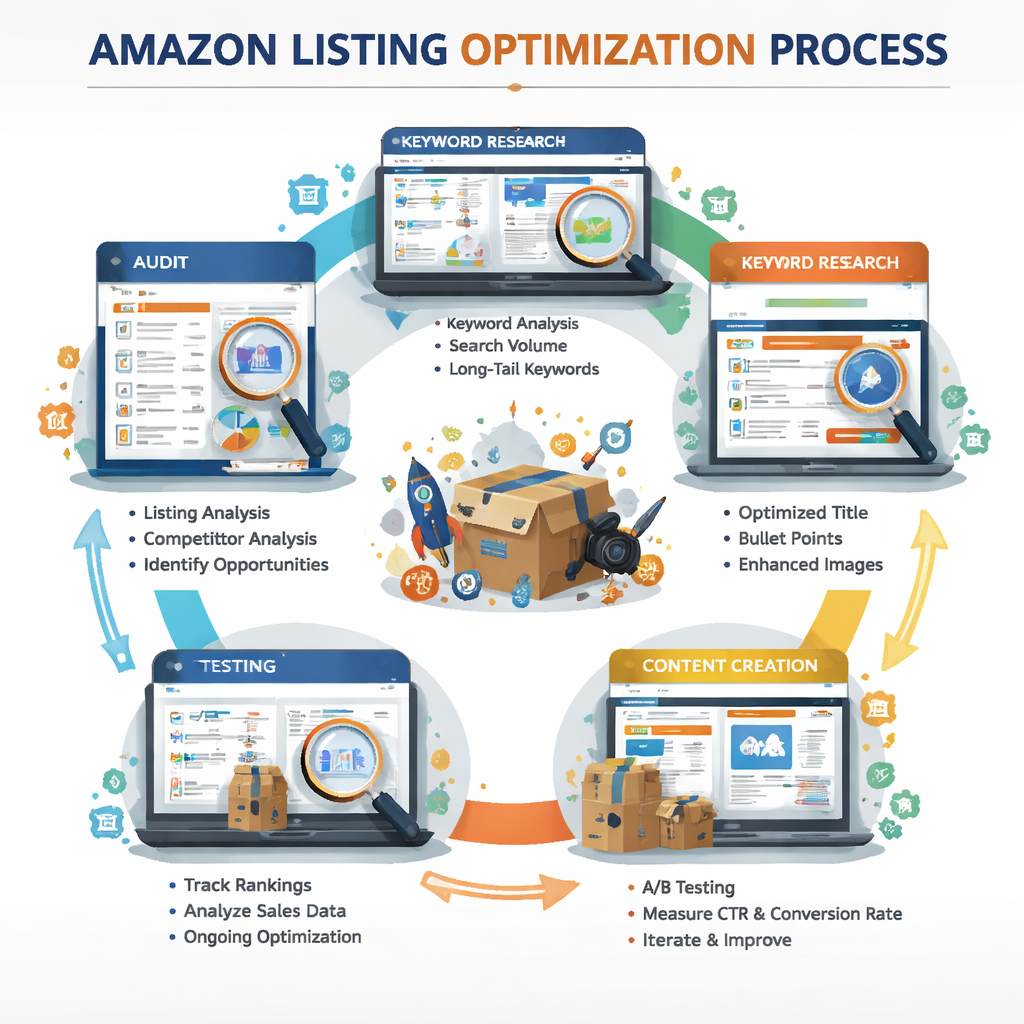
Start by evaluating their initial audit process. Quality providers begin with comprehensive listing analysis: current keyword rankings, competitor positioning, content gaps, and technical issues. They should identify specific problems before proposing solutions. Avoid providers who jump straight to content creation without understanding your current state.
Examine their keyword research methodology. Professional providers use multiple data sources and validation techniques. Amazon's official SEO guidance emphasizes the importance of understanding customer search behavior, not just search volume. Your provider should explain how they identify high-intent keywords that actually drive conversions.
Look for providers who understand the difference between short-tail and long-tail keyword strategies. Short-tail keywords like "wireless headphones" drive volume but face intense competition. Long-tail phrases like "noise-canceling wireless headphones for gym workouts" convert better but have lower search volume. The right mix depends on your competitive position and goals.
Assess their content creation workflow. Professional providers should show you their process for integrating keywords naturally while maintaining readability and persuasive power. They should understand Amazon's character limits, formatting requirements, and best practices for each content section.
Evaluate their approach to A+ Content optimization. This enhanced content format requires different skills than basic bullet points. Providers should demonstrate understanding of visual storytelling, feature-benefit mapping, and mobile optimization. A+ Content isn't just about looking pretty—it's about improving conversion rates.
Ask about their quality control processes. How do they ensure optimized content meets Amazon's guidelines? What's their review and approval workflow? Multiple quality checks prevent costly mistakes that could result in listing suppressions or policy violations.
Review their testing and iteration methodology. The best providers don't just optimize once and walk away. They should have processes for A/B testing different approaches, monitoring performance changes, and making data-driven adjustments. Modern optimization tools now incorporate AI assistance to improve this testing process.
Examine their approach to backend optimization. Search terms, subject matter, and other backend fields significantly impact discoverability. Professional providers should have systematic approaches for maximizing backend keyword coverage without violating Amazon's policies.
Look for providers who understand seasonal optimization. Keyword performance shifts throughout the year. Gift-related terms spike during holidays. Outdoor product keywords peak in spring. Your provider should have processes for updating content to match seasonal search patterns.
Assess their competitive monitoring approach. Amazon's marketplace is dynamic. Competitors launch new products, adjust pricing, and update their own listings constantly. Your optimization strategy needs to evolve with the competitive landscape. Providers should explain how they track and respond to competitive changes.
Evaluate their integration with Amazon's tools and APIs. Advanced providers use Amazon's Brand Analytics, Search Query Performance reports, and other data sources to inform their optimization decisions. They should demonstrate familiarity with these tools and explain how they use the data.
Ask about their approach to multi-variant optimization. Products with multiple colors, sizes, or configurations require different strategies than single-variant items. Your provider should understand how to optimize parent-child relationships and variant-specific content.
Review their documentation and reporting processes. You should receive clear reports showing what changes were made, why they were made, and what results to expect. Transparency in methodology builds trust and enables better collaboration.
Consider their scalability approach. If you have hundreds of products, manual optimization becomes impractical. Look for providers who use systematic approaches, templates, and automation where appropriate. They should explain how they maintain quality while handling large catalogs efficiently.
Examine their crisis management processes. What happens if optimized listings lose rankings or face policy issues? Professional providers should have clear escalation procedures and remediation strategies. They should also carry appropriate insurance for their work.
Finally, assess their knowledge of emerging optimization trends. Amazon continues introducing new features like AI-powered search, enhanced brand content, and video integration. Forward-thinking providers should demonstrate awareness of these developments and plans for incorporating them into their methodology.
The best Amazon product description optimization service providers view optimization as an ongoing process, not a one-time project. Their methodology should reflect this long-term perspective with built-in feedback loops and continuous improvement mechanisms.
Step 5: Evaluate Communication and Reporting Standards
Clear communication and comprehensive reporting separate professional Amazon product description optimization service providers from fly-by-night operations. You need visibility into their work process, regular updates on progress, and detailed performance data to evaluate ROI effectively.
Start by assessing their initial communication style. During the sales process, do they ask thoughtful questions about your business goals, competitive challenges, and success metrics? Or do they pitch a generic solution without understanding your specific needs? Quality providers invest time in understanding your situation before proposing solutions.
Evaluate their project management approach. Professional providers should offer clear timelines, defined deliverables, and regular check-in schedules. They should use project management tools that give you visibility into work progress and upcoming milestones. Avoid providers who can't commit to specific deadlines or deliverable formats.
Examine their reporting capabilities in detail. You need more than just "your rankings improved." Quality reports should include:
- Baseline metrics: Starting position for rankings, traffic, and conversions
- Specific changes made: Exact content modifications and optimization decisions
- Performance tracking: Week-over-week changes in key metrics
- Competitive context: How your performance compares to main competitors
- Next steps: Recommended actions based on current results
Ask to see sample reports from their other clients (with sensitive information redacted). This gives you a clear picture of their reporting quality and depth. Professional providers should have standardized reporting templates that ensure consistency across all client accounts.
Assess their response time commitments. How quickly do they respond to questions or concerns? What's their escalation process for urgent issues? Amazon's fast-moving environment sometimes requires quick responses to ranking drops or policy issues.
Evaluate their knowledge sharing approach. Do they explain their optimization decisions and teach you about Amazon's ecosystem? Or do they keep their methods secret? The best providers view client education as part of their value proposition. They want you to understand why certain strategies work.
Look for providers who offer multiple communication channels. Email works for detailed discussions and documentation. Phone calls or video meetings work better for complex strategy conversations. Instant messaging can be valuable for quick questions or urgent issues.
Review their data access and transparency policies. You should have access to all optimization work performed on your listings. Some providers try to maintain control by limiting client access to their work. This creates dependency and makes it difficult to switch providers if needed.
Ask about their approach to negative results. What happens if optimization efforts don't deliver expected improvements? Professional providers should have clear processes for diagnosing problems, adjusting strategies, and communicating setbacks honestly. Avoid providers who only share good news.
Examine their team communication structure. Will you work with a dedicated account manager, or will you communicate with different team members depending on the issue? Consistent communication contacts reduce confusion and improve relationship quality.
Assess their understanding of your business context. Do they grasp your industry's seasonal patterns, competitive dynamics, and customer behavior? Providers who understand your business can provide more relevant insights and strategic recommendations.
Look for proactive communication practices. Quality providers should reach out with optimization opportunities, market insights, or potential issues before you have to ask. They should monitor your account performance continuously and alert you to significant changes.
Evaluate their documentation standards. All optimization work should be documented clearly with before/after comparisons, rationale for changes, and expected outcomes. This documentation becomes valuable for future optimization efforts and performance analysis.
Consider their approach to collaborative decision-making. While you hire them for their expertise, major strategic decisions should involve your input. Look for providers who present recommendations with clear reasoning but respect your final decision authority.
Finally, assess their long-term relationship approach. Do they view you as a one-time project or a long-term partner? The best Amazon product description optimization service providers focus on building lasting relationships through consistent value delivery and transparent communication.
Remember that communication quality often correlates with service quality. Providers who communicate clearly, respond promptly, and provide detailed reports usually deliver better optimization results than those who don't prioritize client communication.
Step 6: Test with a Pilot Project Before Full Commitment
Smart businesses test before they scale. Running a pilot project with your chosen Amazon product description optimization service provider reduces risk and provides concrete data for evaluating their capabilities. This approach is especially critical for large catalogs where a poor choice could impact hundreds of listings.
Structure your pilot project strategically. Select 5-10 representative products that span different categories, price points, and current performance levels. Include both strong performers and underperformers. This mix gives you a complete picture of the provider's capabilities across different optimization challenges.
Choose pilot products with sufficient data history. You need at least 90 days of baseline performance data to measure improvement accurately. Products with very low traffic or recent launches don't provide reliable testing grounds for optimization effectiveness.
Set clear success metrics before starting the pilot. Define specific targets for organic session growth, conversion rate improvement, and keyword ranking gains. Having concrete benchmarks prevents disputes about project success and provides objective evaluation criteria.
Document your current state thoroughly. Capture baseline metrics for organic sessions, conversion rates, keyword rankings, and Buy Box percentage. Take screenshots of current listings for before/after comparisons. This documentation becomes crucial for measuring pilot project ROI.
Establish a realistic timeline for the pilot. Amazon's algorithm typically takes 2-4 weeks to reflect listing changes in organic rankings. Plan for a 90-day pilot period: 30 days for optimization work, 60 days for performance measurement. Shorter periods don't provide reliable results.
Test their full process during the pilot. Don't just evaluate content quality—assess their research methodology, communication style, reporting accuracy, and timeline adherence. The pilot should give you confidence in their complete service delivery, not just their writing skills.
Monitor competitive responses during the pilot. Your optimization efforts might trigger competitor reactions—price changes, content updates, or increased advertising spend. A good provider should anticipate these dynamics and adjust their strategy accordingly.
Evaluate their problem-solving abilities during the pilot. Amazon's environment is unpredictable. Algorithm updates, policy changes, or competitive shifts might affect your pilot products. How does the provider respond to unexpected challenges? Their crisis management skills matter as much as their optimization expertise.
Track both quantitative and qualitative results. Numbers tell part of the story, but customer feedback, review sentiment, and listing quality improvements also matter. Look for providers who improve both performance metrics and customer experience.
Use the pilot to assess scalability. Can they maintain quality standards when handling multiple products simultaneously? Do their processes work efficiently at larger volumes? Pilot projects should demonstrate their ability to handle your full catalog size.
Test their reporting and communication during the pilot. Are their progress updates detailed and actionable? Do they proactively identify issues and opportunities? Communication quality during the pilot predicts long-term relationship success.
Compare pilot results against your internal benchmarks and industry standards. A 15% improvement in conversion rate might sound impressive, but it's mediocre if industry leaders achieve 30% gains. Context matters for evaluating provider performance.
Document lessons learned from the pilot project. What worked well? What could be improved? Which of their recommendations delivered the best results? This analysis informs your decision about full engagement and helps optimize the ongoing relationship.
Consider running parallel pilots with multiple providers if your budget allows. This approach provides direct performance comparisons and gives you negotiating leverage for the full engagement. However, ensure pilot products don't overlap to avoid skewed results.
Use pilot project results to negotiate better terms for the full engagement. Strong pilot performance gives you confidence to commit to larger volumes. Weak results give you leverage to negotiate improved service levels or pricing adjustments.
Plan your transition strategy from pilot to full engagement. Which products should be optimized first? How will you scale the relationship while maintaining quality? The pilot should inform your rollout strategy for the complete catalog.
Finally, remember that pilot projects work both ways. The provider is also evaluating whether your business is a good fit for their services. Be responsive, provide necessary access, and communicate clearly during the pilot. Good partnerships require effort from both sides.
A well-structured pilot project provides the data you need to make confident decisions about your Amazon product description optimization service provider. It's a small investment that can prevent costly mistakes and ensure successful long-term partnerships.
Frequently Asked Questions
What should I expect to pay for Amazon product description optimization services?
Pricing varies significantly based on service scope and provider type. Full-service agencies typically charge $200-500 per listing for comprehensive optimization including keyword research, content creation, and A+ Content. Specialist providers may charge $150-300 per listing, while freelancers often work for $50-150 per listing. For large catalogs, continuous optimization systems may offer better value through monthly retainer models. Factor in ongoing maintenance costs, as optimization isn't a one-time fix but requires regular updates to maintain effectiveness.
How long does it take to see results from listing optimization?
Amazon's algorithm typically takes 2-4 weeks to reflect listing changes in search rankings. However, meaningful performance improvements usually require 60-90 days to fully materialize. Conversion rate improvements may appear faster, within 2-3 weeks, as better content immediately impacts visitor behavior. Organic ranking improvements take longer because they depend on accumulated performance signals over time. Be wary of providers promising overnight results, as sustainable optimization requires time for Amazon's systems to recognize and reward improvements.
Should I choose a provider that offers AI-powered optimization?
AI assistance can improve optimization efficiency and consistency, but it's not automatically better than human expertise. Our research found that only 33% of Amazon product description optimization services incorporate AI, with just 11% offering advanced AI capabilities. The key is finding providers who combine AI tools with human expertise and category knowledge. AI excels at data analysis and pattern recognition, while humans provide strategic thinking and creative problem-solving. Look for providers who use AI to enhance their process rather than replace human judgment entirely.
What's the difference between organic and PPC optimization for Amazon listings?
Organic optimization focuses on improving natural search rankings through better listing content, keyword integration, and customer experience signals. PPC optimization involves managing sponsored product campaigns to drive paid traffic. However, these strategies are interconnected—strong organic listings improve PPC performance by increasing Quality Scores and conversion rates. The best Amazon product description optimization service providers understand both channels and can align your organic content strategy with your advertising goals for maximum effectiveness across all traffic sources.
How do I know if my current listings need optimization?
Key indicators include declining organic sessions despite stable search volume, low click-through rates on high-impression keywords, conversion rates below category averages, and poor rankings for relevant search terms. Use Amazon's Search Query Performance report to identify keywords where you're getting impressions but few clicks. Compare your listing quality against top competitors in your category. If your content feels generic, lacks specific benefits, or doesn't address customer questions effectively, optimization can likely deliver meaningful improvements.
What happens if Amazon changes its algorithm after my listings are optimized?
Algorithm updates are normal and ongoing in Amazon's ecosystem. Professional providers should monitor these changes and adjust strategies accordingly. This is why choosing a provider with continuous optimization capabilities is important for large catalogs. One-time optimization projects can become outdated quickly, while ongoing relationships allow for strategic adjustments as Amazon's platform evolves. Ask potential providers about their approach to algorithm updates and how they keep client listings current with platform changes.
Can I optimize my listings myself instead of hiring a service?
Self-optimization is possible for small catalogs with dedicated internal resources. Amazon provides free tools and guidance through Seller Central. However, professional optimization requires deep platform expertise, keyword research tools, competitive analysis capabilities, and ongoing monitoring systems. For catalogs with 50+ products, the time investment and learning curve often make professional services more cost-effective. Consider your opportunity cost—time spent learning optimization could be invested in other business growth activities where you have stronger expertise.
How do I measure the ROI of Amazon listing optimization?
Track key metrics before and after optimization: organic sessions, conversion rates, average selling price, and total organic revenue. Calculate the revenue increase attributable to optimization and compare it to your service investment. Factor in the compounding effect—optimization improvements typically grow over time as rankings improve and customer signals strengthen. Most successful Amazon product description optimization service engagements deliver 20-50% improvements in organic performance within 90 days. Document baseline metrics carefully to ensure accurate ROI calculations and avoid attributing unrelated performance changes to optimization efforts.
Conclusion
Choosing the right Amazon product description optimization service requires systematic evaluation across multiple dimensions. Start by defining clear goals and realistic budgets that account for your catalog size and business objectives. Research providers thoroughly, focusing on their Amazon-specific expertise rather than general marketing credentials.
Evaluate their optimization methodology and ensure they follow structured, transparent processes. Communication and reporting standards matter as much as technical skills—you need providers who can explain their work and demonstrate results clearly. Most importantly, test their capabilities through a well-designed pilot project before committing to your full catalog.
Remember that optimization is an ongoing process, not a one-time project. Amazon's algorithm, competitive landscape, and customer behavior evolve continuously. The best providers understand this dynamic environment and offer systematic approaches that adapt to change rather than static solutions that become outdated.
Whether you choose a full-service agency, specialist provider, or continuous optimization system depends on your specific needs, resources, and growth trajectory. The key is matching provider capabilities with your business requirements while maintaining realistic expectations about timelines and results.
Take time to evaluate providers properly. The decision impacts your marketplace performance for months or years. A thorough selection process upfront prevents costly mistakes and ensures you find a partner who can genuinely improve your Amazon success. Your listings are the foundation of your marketplace presence—invest in optimizing them correctly.
Want this done for your catalogue automatically?
Get a free catalogue scan